The guideSelling a collection
Selling a collection
Put a price on the part that took work to find.
Any public list can carry a price. Buyers read the first few items free, then pay once for permanent access to the rest, including anything you add later. Kyurations keeps 30 percent and you keep 70. Payouts go out weekly to a UPI ID or a bank account, and buyers can ask for a refund within seven days.
How a paid collection reads
A paid list is not a locked door. The opening items are readable by anybody, in full, exactly as they would be on a free collection. The page then says plainly how much more there is and what it costs.
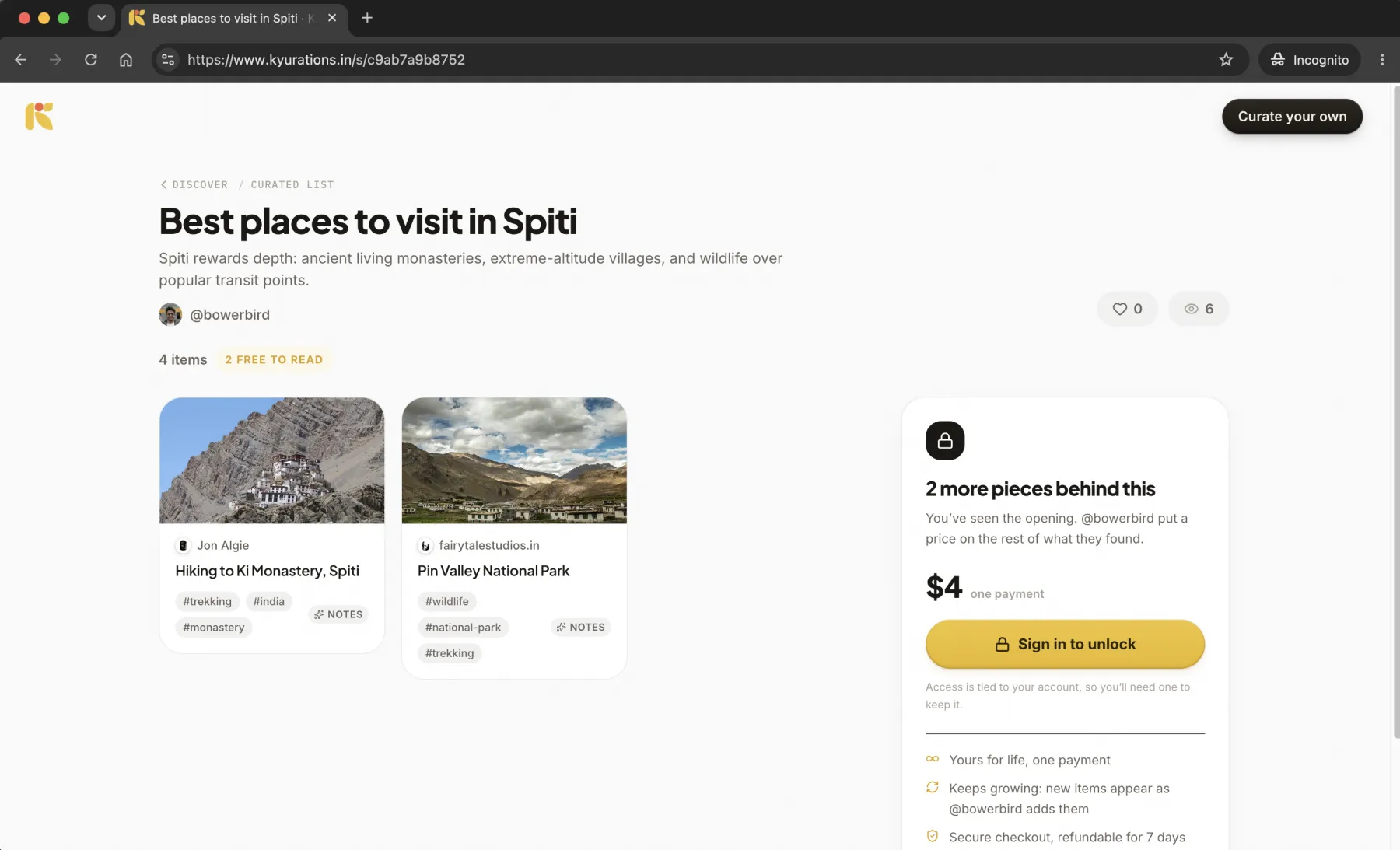
The sample is the argument. Somebody who has read two of your picks and wants the other twelve is a much better buyer than somebody staring at a blurred grid.
What a buyer gets
- The whole collection, permanently, for one payment. There is no subscription.
- Everything you add to that list afterwards, at no further cost. A collection that keeps growing is worth more than a collection frozen at the moment of sale.
- Access tied to their account rather than to a link, so it survives a new device.
- Seven days to ask for a refund if the collection was not what the page described.
A purchase is a grant, not a copy. The buyer is reading your list, so when you improve it, their copy improves. Nothing is duplicated into their library.
Setting a price
- 1Publish the list. Selling runs on top of a public link, so the list has to be public first.
- 2Turn on Sell. It sits in the same share dialog as the public link, under Quick settings.
- 3Set the price and the free sample. Choose what it costs and how many items stay open to everyone.
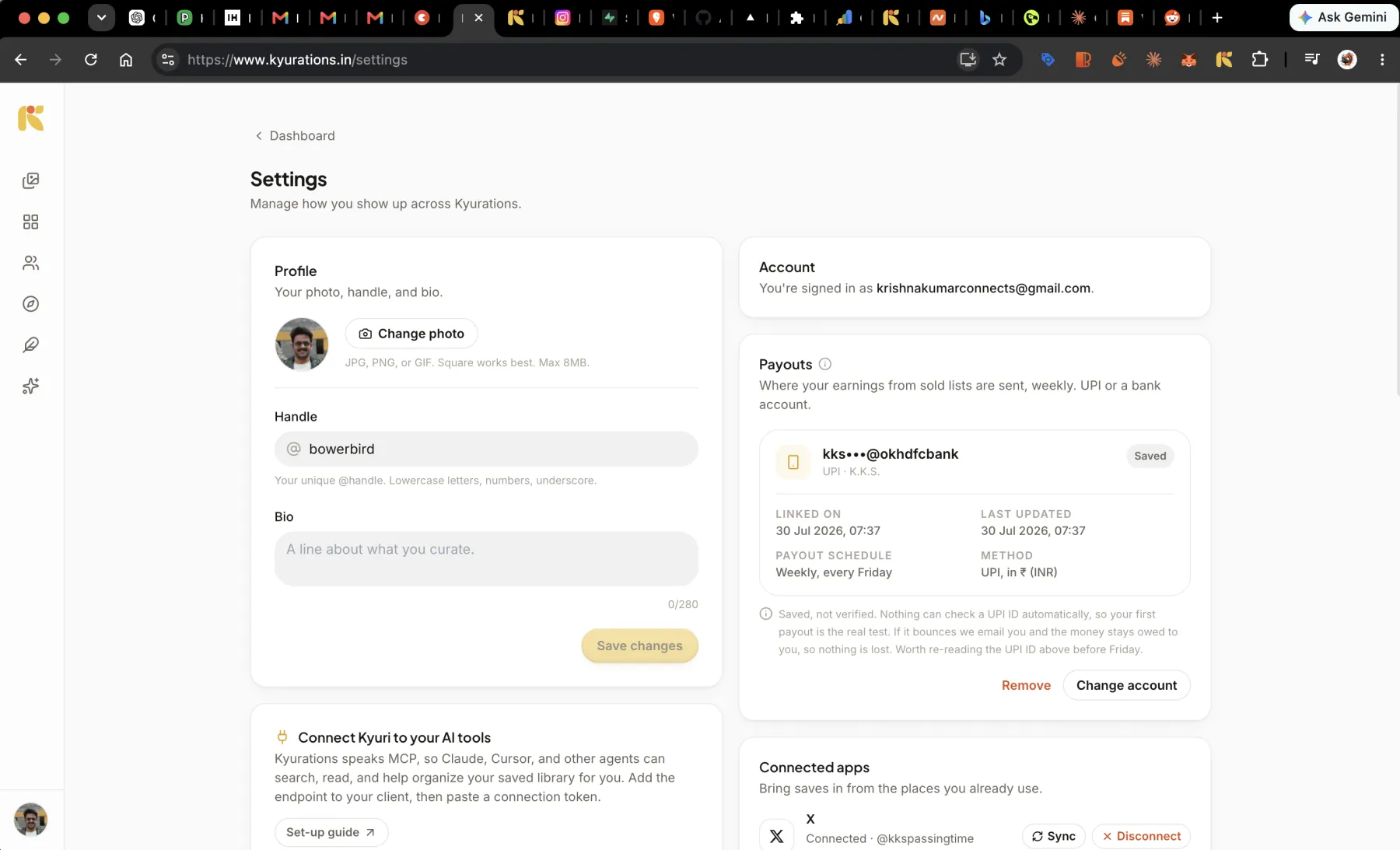
- 4Add a payout destination. In Settings, under Payouts. Without one the money is still owed to you, it just has nowhere to go.
The split, and getting paid
You keep 70 percent of each sale. Kyurations keeps 30, which covers payment processing, the merchant-of-record obligations and the hosting.
Payouts run weekly, every Friday, to a UPI ID or a bank account. A destination counts as verified only once money has actually landed in it, so a freshly entered UPI ID reads as saved rather than as confirmed until the first payout clears.
The Earnings page shows what has sold, what is pending and what has been paid. It only appears for people who actually sell.
Refunds and disputes
A buyer who writes in within seven days, because the collection was not what the page said it was, gets their money back and loses access. Refunds are reconciled against the original payment, so a refunded sale stops counting toward your earnings rather than being paid out and clawed back later.
Questions
- What does it cost to sell?
- Nothing up front. Kyurations takes 30 percent of a sale and you keep 70. If nothing sells, nothing is charged.
- Can I sell a list and also run it as a newsletter?
- Yes. They are separate switches on the same public list. A paid collection with a newsletter keeps mailing its buyers as it grows.
- What currency do buyers pay in, and what do I get paid in?
- Prices are set in dollars. Payouts to a UPI destination are made in rupees. The Earnings page shows both what was charged and what is owed to you.
- Do buyers keep access if I delete the list?
- Deleting a collection you have sold takes away what somebody paid for, so it is not something to do casually. The commercial terms, including what buyers are owed, are set out on the selling page.