
KyurationsCurate your own
@bowerbirdCurated list

AI concepts, tips & tricks

@bowerbird
7
10 items

Engineering leaders in Bangalore on AI transformation failure modes

x.comArnav Gupta (@championswimmer) · Post

A tech leader discusses four major failure modes observed among engineering leaders and teams in Bangalore attempting AI transformation. Mid-senior engineers often struggle with identity loss and fear of automation rather than experimenting at the boundaries of AI capabilities. Many teams conflate LLM capabilities with proper agentic design, dumping unstructured tasks into APIs instead of building pipelines with deterministic preprocessing, cognitive work, and postprocessing stages. Teams still operate with CRUD-era backend models and limited tool use rather than sandboxed VM environments where agents can work autonomously with guardrails. Finally, non-technical executives and PMs are generating rapid MVPs with Claude but lack accountability, design judgment, and operational ownership, creating friction and trust erosion with engineers responsible for production systems.

A Claude Skill for Rigorous Problem-Solving

x.comArchie Sengupta (@archiexzzz) · Post

Skill for Claude: A comprehensive guide to first-principles reasoning that breaks down problems to their irreducible axioms rather than accepting historical precedent or industry consensus. The post traces the concept from Aristotle through modern practitioners like Elon Musk, establishing that this approach involves: surfacing all unstated assumptions, reducing problems to fundamental truths (physics, mathematics, material costs), computing theoretical lower bounds, rebuilding solutions from axioms alone, and stress-testing conclusions. Real-world examples demonstrate the technique's power: SpaceX identified that 98% of rocket costs were manufacturing inefficiency rather than material necessity, and Tesla's battery analysis revealed a similar gap between fundamental constituent costs and industry prices. The guide provides a mandatory five-step reasoning protocol and operational heuristics including the 'idiot index' (finished cost divided by raw-material cost) as a diagnostic tool for identifying breakthrough opportunities. This contrasts sharply with analogical reasoning, which most people default to, and emphasizes deletion, simplification, and radical architectural redesign as default tools when the efficiency gap is high.

Clay's Official AI Writing Policy

linkedin.comVarun Anand · Post

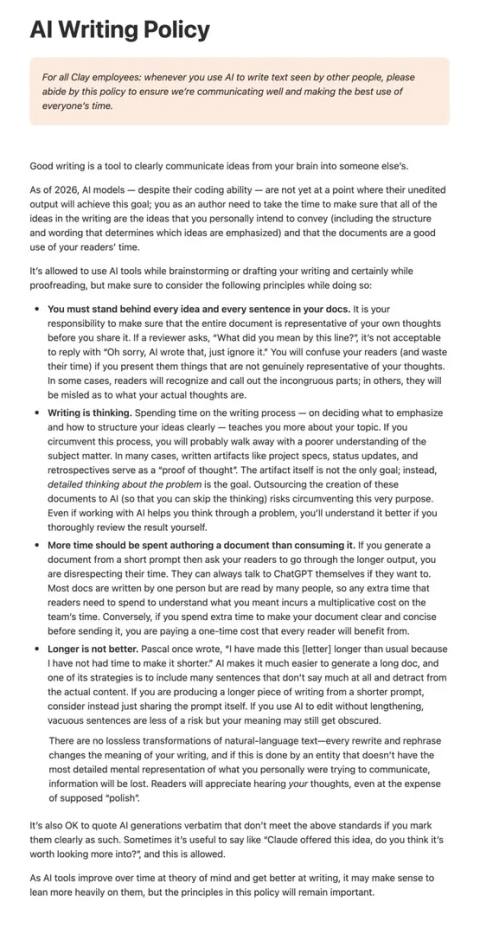
Clay implemented a company-wide AI writing policy with four core principles: writers must stand behind every idea in their documents, writing itself is a thinking process that deepens understanding, more effort should go into producing documents than consuming them, and length does not equal quality. The policy emphasizes that generating verbose output from short prompts disrespects readers' time and that AI's tendency to pad documents with filler sentences should be resisted. Originally developed for the engineering team, the policy proved valuable enough to expand across all departments.

The biggest opportunities right now

x.comGREG ISENBERG (@gregisenberg) · Post

Greg Isenberg outlines 25 emerging business opportunities across technology, social needs, and market gaps created by AI proliferation. Key themes include solving loneliness and burnout as AI generates increasing volumes of content, building verification and trust systems for deepfakes, creating tools for newly automated workers, and capturing emerging vertical markets where legacy software remains entrenched. Other opportunities span AI enablement for businesses stuck on ChatGPT, reviving abandoned software with AI maintenance, outcome-based pricing models replacing per-seat licensing, and addressing demographic shifts like aging populations and caregiving demands. The list emphasizes both technological solutions (AI agents for business operations, fraud protection for AI spending) and human-centered needs (longevity, spirituality, analog/physical experiences as status symbols).

How to Build Good Taste

youtube.comThe Cutting Edge School · Video

Taste is a learnable skill demonstrated by figures like Virgil Abloh and Steve Jobs, built not through formal training but through intentional exposure and consumption patterns. The video presents three core methods: consuming outside your algorithm by deliberately exposing yourself to diverse fields and experiences beyond your professional niche; consuming intentionally by actively observing and deconstructing what makes good design work; and consuming from the right resources rather than relying solely on algorithm-driven recommendations. A personal example shows how the creator avoided expensive designer fees by curating aesthetic inspiration from Pinterest and using AI tools like Gemini to systematize design choices, then building a FigJam board to translate inspiration into actionable office renovation plans. The key insight is that taste develops through accumulated high-quality experiences and deliberate observation across multiple domains, not through formalized rules or shortcuts.

#design#creativity#learning#concept#art fundamentals

Using LLMs to Build Personal Knowledge Bases

x.comAndrej Karpathy (@karpathy) · Post

Andrej Karpathy describes a workflow for building and maintaining personal research knowledge bases using LLMs and Obsidian. Raw source documents are collected into a directory, then an LLM automatically compiles them into a structured markdown wiki with summaries, backlinks, and conceptual organization. Obsidian serves as the IDE frontend for viewing raw data, the compiled wiki, and visualizations, while the LLM handles all writing and maintenance. Once the wiki reaches sufficient size (e.g., 100+ articles, 400K words), users can query the LLM agent to answer complex questions and generate various output formats like markdown files, slides, and visualizations. The system also includes automated health checks to find inconsistencies, impute missing data, and suggest new article candidates. Rather than requiring fancy RAG systems, the LLM manages index files and summaries effectively at this scale. The approach encourages iterative enhancement as query outputs are filed back into the wiki, and future possibilities include synthetic data generation and finetuning to embed knowledge directly into the model's weights.

#ai#learning#knowledge management#automation#developer tools#developer

Claude Pro 50% off discount for 3 months

x.comShantanu Goel (@shantanugoel) · Post

A Twitter user shares a promotional link offering Claude Pro at 50% off ($10/month) for 3 months. They note they found it on Reddit, tested it themselves, and confirm it works, though they include a disclaimer that it's not their link and they can't guarantee its status.

#claude#ai saas#discount#ai#pricing

High Attribution and Autonomy AI Products Provide Pricing Power and Enable

x.comRahul Mathur (@Rahul_J_Mathur) · Post

AI products with high attribution (clear value demonstration) and high autonomy (minimal user involvement) command pricing power and can charge based on outcomes rather than usage. Madhavan Ramanujam's 2x2 framework mapping these dimensions is presented as a critical strategic tool for AI product builders.

#ai#ai saas#pricing#product strategy#autonomy#attribution

AI creates slop primarily because it is unconstrained due to zero marginal cost

x.comAviral Bhatnagar (@aviralbhat) · Post

AI systems produce low-quality output because they operate without the natural constraints that limit human creators. Human creativity is filtered through scarcity of time, energy, and attention, which drives quality; in contrast, AI's zero marginal cost removes these limiting forces. The argument suggests that beauty and meaningful work emerge from constraints, and unconstrained abundance naturally tends toward mediocrity.

10 underused AI art styles for differentiation

instagram.comReel

A visual guide showcasing ten distinctive techniques for AI art that stand out from generic outputs, including fat pixel, 16-bit sprite, terminal, risograph, ASCII, CMYK dots, halftone print, dithered 1-bit, punk collage, and bootleg pixel styles. These underutilized aesthetic directions help creators differentiate their work and move beyond homogenized AI imagery.

About this collection

AI concepts, tips & tricks is a collection of 10 things about ai, ai saas and product strategy, arranged by @bowerbird on Kyurations.

Published · Updated

Subjects:aiai saasproduct strategydesigndeveloperlearningai-generated contentautomation

More collections on ai